
How Long Does It Take to Become a Transcriptionist? A Realistic Timeline From First Lesson to First Client
“How much does it pay?” is the first question people ask about transcription. “How long will it take me?” is the second, and it’s the one that decides whether you actually start.
So here’s a straight answer, based on what we’ve watched thousands of students do: most people who train seriously are working-ready in two to four months for general transcription, and somewhat longer for legal. Some finish faster. Plenty take longer, on purpose, because life is busy and the course doesn’t expire.
What follows is the realistic version of that timeline: what happens in each phase, the three things that set your pace, and what our graduates’ first-client stories actually look like.
The short answer
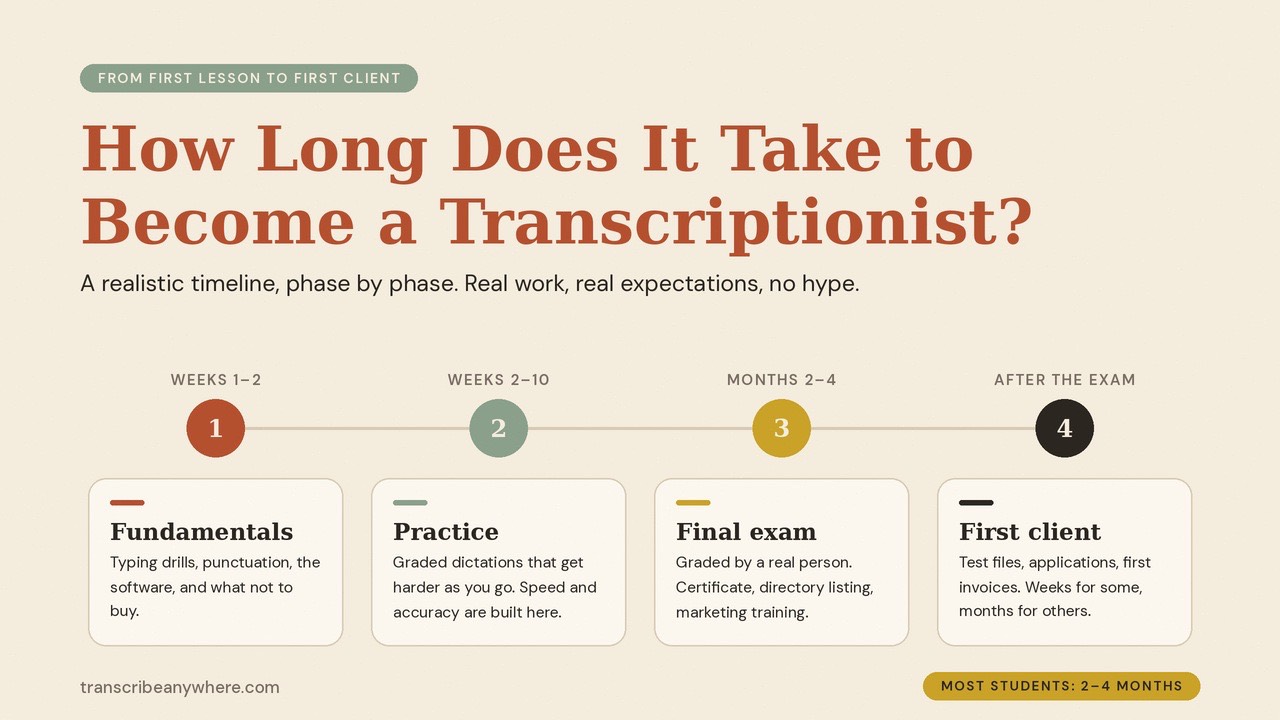
- Weeks 1–2: Fundamentals. Typing drills, a grammar and punctuation foundation, the software, and what equipment you actually need (less than you think).
- Weeks 2–10: Practice. Graded practice dictations that get harder as you go: multiple speakers, accents, background noise, technical vocabulary. This is where speed and accuracy are built.
- Months 2–4: The final exam. Graded by a real person, not software. Pass it and you get your certificate, your graduate directory listing, and the marketing and business training.
- After the exam: First clients. Test files, applications, and your first invoices. For some graduates this takes weeks; for others, a few months.
Think of it as a part-time project measured in weeks, not a weekend. It is real training for real work, and the people who treat it that way are the ones who finish.
What actually sets your pace
Three things, and none of them is talent.
- Hours per week. This is the big one. Five focused hours a week tends to be a four-month course. Ten to twelve is closer to two. Weekly consistency beats occasional marathons: transcription is a physical skill, like typing or playing an instrument, and skills built in short, regular sessions are the ones that stick.
- Where you’re starting from. Typing speed matters less at the start than people expect. Many successful transcriptionists begin near 60 words per minute and build from there. Grammar and punctuation matter more. If commas already make sense to you, you’ll move through the foundation quickly. If they don’t, the foundation is where you’ll spend your time, and it’s time well spent, because punctuation is what separates a transcript a client accepts from one they send back.
- General or legal. General Transcription: Theory & Practice™ has seven levels of practice dictations. Legal Transcription: Theory & Practice™ has ten, plus fourteen training modules and more than a hundred pages of legal terminology, because you’re learning a vocabulary and a set of document formats along with the skill. Most students finish general in two to four months; legal typically runs longer. If you’re taking both, general first is the natural order. (Not sure which fits you? Start with General vs. Legal Transcription: Which Path Is Right for You?)
A realistic timeline, phase by phase
Weeks 1–2: Setup and fundamentals
The first thing you’ll learn is what not to buy. Beginners often spend hundreds of dollars on equipment before they’ve transcribed a minute of audio. You don’t need to. A reliable computer, a decent pair of headphones, and transcription playback software are enough to start. A foot pedal is a productivity upgrade you can add once you know you’ll use it. (Inside the course we tell you where to get the best deals, but the advice is the same: don’t buy it before you start.)
The rest of these first weeks goes to the foundation: typing drills, the grammar and punctuation rules transcription relies on, and getting comfortable with the software. It isn’t glamorous. It’s also the part most self-taught transcriptionists skip, and it’s where their trouble starts.
Weeks 2–10: Practice, and the ratio that matters
Here’s the number that runs your income as a transcriptionist: how many hours of work it takes you to produce one hour of finished audio. Professionals typically land around three to four working hours per audio hour. Beginners start much higher, often six or more.
The practice levels are where that ratio comes down. Each level is real-world audio with a full answer key, and each one is harder than the last. You’ll transcribe, compare, fix, and repeat. Text expanders and shortcut keys come in here too, and they’re worth more to your speed than any typing drill.
If you want a milestone to aim for: when you can transcribe a difficult file cleanly at roughly four hours per audio hour, you’re within reach of professional pace. That usually happens somewhere in the back half of the practice levels, and you’ll feel it when it does.
Months 2–4: The final exam
The exam is graded by a real person, and it’s meant to be passed by people who did the practice, not by people who skimmed it. Passing it earns your certificate of completion, a listing in our official graduate directory, and the marketing and business training that shows you how to find higher-paying work as an independent contractor, including how to set up your own website.
For graduates who want a professional credential on top, Transcribe Anywhere is an AAERT-approved school, and AAERT offers the Certified Electronic Transcriber (CET) exam.
After the exam: The first-client window
This is the part nobody can put a fixed number on, so here’s what it has looked like for three of our graduates.
Leslie Kaminski took the General Transcription course while living overseas and needing income she could earn remotely.
“Within two weeks of passing the final exam, I was contracted by an American agency that specializes in qualitative research.”
Jennifer Fulton enrolled after about twenty years in a corporate job. She took general first, then legal, and didn’t wait for the second certificate.
“I was able to contract with a company before I had even finished the legal transcription course.”
The company was advertising for someone with experience. She applied anyway, because the practice work meant she could honestly say she had experience with everything they asked about: different software, strict versus standard verbatim, time-stamping.
Kelli Harvey finished her legal course, then applied to an agency a few months later, looking for steady work without a weekly minimum. They asked for test files.
“I was prepared for the job and did well on those test files thanks to the skills I learned through Transcribe Anywhere.”
Three graduates, three different clocks: two weeks, before the course was even finished, and a few months on her own schedule. What they had in common is that none of them waited to feel ready before applying. The test files did the convincing. Every graduate’s timeline is different, and no training can guarantee client work, but trained applicants walk into those test files with a real advantage. (You can read Leslie’s full story here.)
What slows people down
After watching a lot of students start, we can tell you the four things that stretch a three-month timeline into a year:
- Buying gear first. A foot pedal and a $300 headset don’t make you faster in week one. Practice does. Start with what you have.
- Practicing in bursts. Eight hours on a Sunday and nothing for two weeks feels productive and isn’t. Your ears and your fingers need repetition, not intensity.
- Skipping the foundation. “I can already type” is the most common reason people jump straight to practice files, and it’s the most common reason their transcripts come back covered in corrections. (We wrote about this in I Can Type… Can’t You Just Tell Me How to Get Clients?)
- Waiting to feel ready before applying. Nobody feels ready. Test files exist so companies can decide for you, and they’re a lot less scary once you’ve done ten levels of practice.
And one more that isn’t about effort: going it alone. Free videos can show you the software. They can’t grade your practice, answer the question you have at nine at night, or tell you which companies hire beginners. People who piece it together on their own can absolutely get there; it just tends to take longer and cost more in bad first jobs. (Can a Transcription Course Actually Help You Get Work in 2026? goes deeper on that trade-off.)
The cost of waiting (the honest math)
There’s a version of this decision that sounds responsible: “I’ll start when things calm down.” Here’s what the calendar does with that.
If you start this week and put in six or seven hours a week, you’re sitting for the final exam in roughly three months and applying for work in month four. If you wait three months to start, you’re doing exactly the same thing three months later. Nothing about the course gets shorter, and nothing about your schedule gets emptier. The only thing that moves is the date on your first invoice.
Ninety days from now, you’ll be one of two people: three months into a skill, or three months away from where you could have been. Both are fine choices. Only one of them is a decision.
Where to start
If you’re not sure transcription suits you, don’t start with a course. Start with the free mini-course: seven short lessons, real expectations, and a clear next step. It costs nothing but an email address, and it’s honest about who this work isn’t for.
If you already know you want in, pick a path:
- General Transcription is the fastest route to working and the widest range of clients: podcasts, business, media, research, education.
- Legal Transcription is a longer course with a specialized vocabulary, and higher rates on the other side. (See How Much Do Transcriptionists Make in 2026? for the numbers.)
- Both if you want the option to move between markets later.
Either way, the course is self-paced with lifetime access, so the timeline above is yours to set. The only date that matters is the one you start.
Free Transcription Course for Beginners
Discover a Real Work-From-Home Skill — and See If It's Right for You
Seven short lessons. Real expectations. A clear next step.