
How Much Do Transcriptionists Make in 2026? Real Numbers, No Hype
“How much do transcriptionists make?” is the first question almost everyone asks — and it’s the right question. Before you invest time in learning a new skill, you deserve real numbers, not recruiting hype.
So here they are, pulled from the major salary trackers and the U.S. Bureau of Labor Statistics, along with the context those sites leave out: what beginners actually earn, why “per audio hour” isn’t the same as “per hour worked,” and how transcriptionists move up the pay scale.
New to transcription? Start with our step-by-step guide on how to become a transcriptionist.
The short answer
Most working transcriptionists in the U.S. earn somewhere between $20 and $29 per hour in 2026, depending on specialty and experience:
- Indeed reports an average of $26.38/hour for transcriptionists.
- ZipRecruiter puts the average at about $41,995/year (roughly $20/hour).
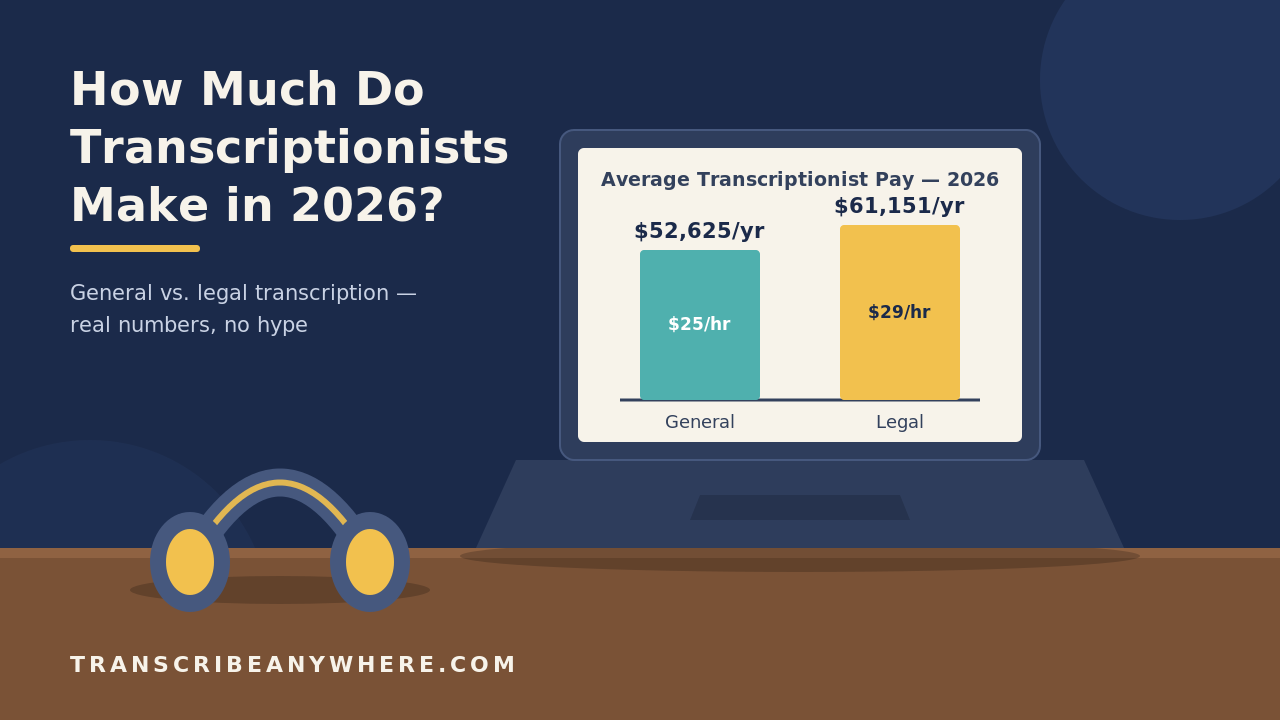
- Glassdoor lists legal transcriptionists at an average of $61,151/year — about $29/hour.
Averages hide a wide range, though. The bottom of the market, auto-generated “clean up this AI transcript for pennies” gigs, pays poorly and always has. The top, skilled legal work for court reporting firms and law offices, pays well and is holding steady. Where you land depends almost entirely on your skills and your niche.
How transcriptionists actually get paid
Very few transcription clients pay a flat hourly wage. Most freelance work is priced per audio hour (or per audio minute, or per page for legal work). This is the single most misunderstood number in the industry, so let’s be honest about it:
One audio hour is not one hour of work. A typical professional takes three to four working hours to transcribe one hour of audio once you account for difficult speakers, research, and proofreading. Beginners take longer.
So when you see rates like these:
- General transcription: roughly $45–$90 per audio hour for professional-level work
- Legal transcription: typically higher, with freelance rates in the $20–$45/hour range and per-page rates common for court work
Divide by your real working time to estimate your effective hourly rate. A trained general transcriptionist earning $60 per audio hour who works at a 3:1 ratio is making about $20/hour. A faster, more accurate transcriptionist doing the same job at 2.5:1 makes $24/hour for identical work. Speed and accuracy are literally money, which is why training matters more in this field than in most.
What beginners really earn
Your first months will pay less than the averages above. That’s true in transcription just like any skilled trade. Untrained beginners taking whatever they can find on content-mill platforms often earn under $10/hour in real terms, which is where transcription gets its unfair “it doesn’t pay” reputation.
Training helps you skip much of that stage. When you can pass a transcription test, format documents correctly, and deliver clean files the first time, you are ready to apply to the companies and private clients that pay professional rates. The gap between “I can type” and “I’m a trained transcriptionist” is the gap between those two pay levels. (We wrote about why typing skills alone aren’t enough in I Can Type… Can’t You Just Tell Me How to Get Clients?)
Why legal transcription pays more
The numbers above show a consistent pattern: legal transcription out-earns general transcription by a meaningful margin. Glassdoor’s averages put the gap at roughly $8,500 per year.
The reasons are simple:
- Specialized knowledge. Legal terminology, formatting rules, and certification requirements shrink the pool of qualified transcriptionists.
- Accuracy stakes. Court records and legal documents can’t tolerate errors, so law firms and court reporting agencies pay for proven skill.
- AI can’t be certified. Legal transcripts often require a human who can attest to their accuracy — a requirement no software can meet. (More on that in The 6 Things AI Transcription Gets Wrong.)
At the very top of this ladder, BLS data shows the highest-earning 10% of court reporters and captioners make over $127,000/year. That’s not a typical outcome, but it shows how high the ceiling goes for people who keep building legal skills.
With that said, there's no shortage of general transcription work and, in many cases, it offers a very wide variety of potential clients. These include:
- Social Media Influencers
- Podcasters
- Businesses and Corporations
- Financial Services Companies
- Market Research and Consulting Firms
- Entertainment and Video Production Companies
- Media Professionals
- Government Agencies
- Religious Organizations
- Real Estate Professionals
- Academic and Educational Institutions
- Research Institutions
- Authors
- E-learning Companies
- Marketers
- Personal Development Coaches and Public Speakers
and more.
What actually determines your income
After years of training students, we’ve seen the same five factors decide earnings again and again:
- Training. Trained transcriptionists can apply to higher-paying companies and private clients.
- Speed-to-accuracy ratio. Cutting your turnaround from 4:1 to 3:1 is an instant 33% raise.
- Niche. Legal and other specialized work consistently pays more than general content.
- Client type. Private clients pay more than platform. Direct relationships beat middlemen.
- Hours you choose to work. Most of our students freelance, so income scales with the workload they want — part-time side income or full-time career.
Is the income worth it to you?
Only you can answer that. It depends on whether you want side income or a full-time career, and how much flexibility is worth to you. Transcription won’t make anyone rich overnight, and anyone who promises that is selling hype. What it offers is a real, learnable skill and control over where and when you work. The averages above give you a realistic range.
You also have the opportunity to expand your business and hire subcontractors as you gain more clients than you can comfortably transcribe on your own. Again, it's up to you. Work as much or as little as you like.
If you want step-by-step training, our General Transcription course and Legal Transcription course walk you through it, from your first practice file to your first client.
If you want to find out whether the work itself suits you, before spending anything, start with our free mini-course. Seven short lessons, real expectations, and a clear next step.
Sources: Indeed, ZipRecruiter, Glassdoor, U.S. Bureau of Labor Statistics. Figures reflect data published as of July 2026.
Free Transcription Course for Beginners
Discover a Real Work-From-Home Skill — and See If It's Right for You
Seven short lessons. Real expectations. A clear next step.